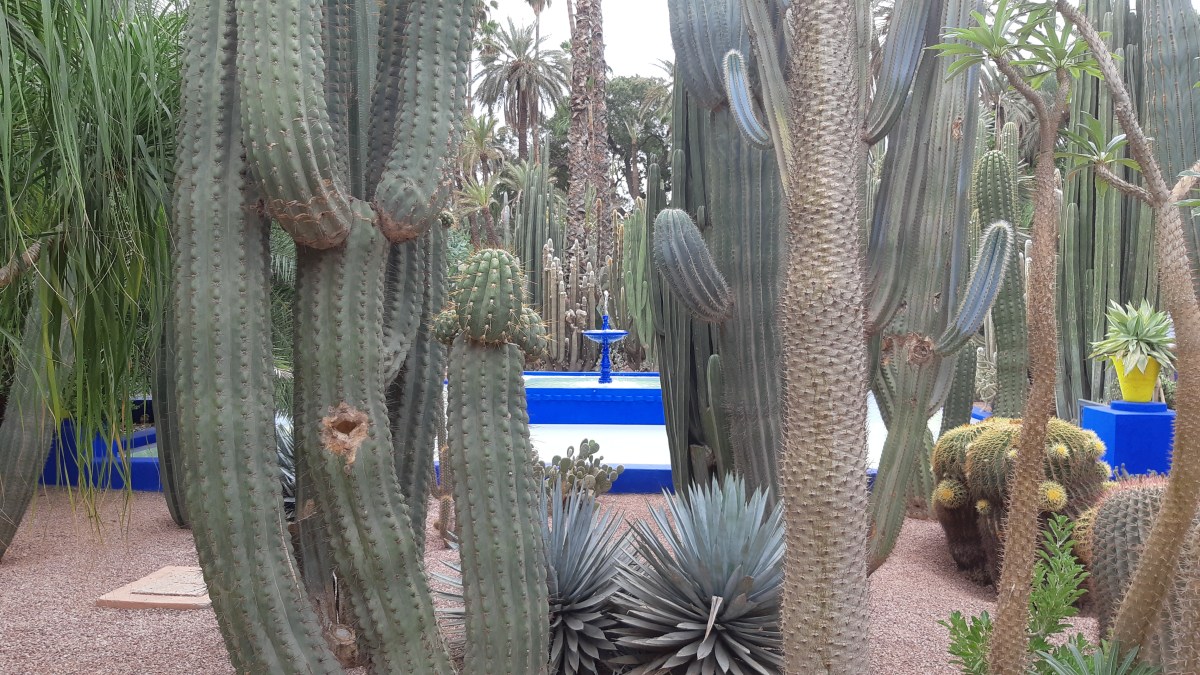
Summer in Marrakech

I use to be a fan of the summer season in any part of the world, but that changed when I visited Dubai one early August. Since then, I have avoided the Gulf countries in summer and kept myself under the shade in the Middle East generally.

I wanted to get familiar with the North-West African dialects and decided to give Marrakech a try. I contacted a language centre, asking about studying the Moroccan Arabic dialect, Darija, intending for some time in October. This was during the Coronavirus 2019 pandemic and I was unsure whether any centre was teaching face-to-face these days.

The director of Study Arabic Marrakech was positive and advised me that he was expecting level one students (more or less) in September, suggesting I consider this option. Determined to end my fear of contagion and be a global citizen again, I made plans to visit Morocco. I informed the director and completed the online enrolment form.

Initially, it was really nice to visit Marrakech.  There is a lot to see and experience. There is the old city, which is the main attraction, then there is the new city where there are nice cafes, such as Cappuccino near Avenue Echouhada. Also, there is the countryside and mountains nearby.

However, due to the summer heat, I was unable to sleep. Also, I have never been a fan of air conditioning, but without it, being indoors was unbearable. Anywhere north of Marrakech would of been perfect. During the months of July, August and September, if you are planning to study, then Marrakech is better avoided.  Having said that, the city is full of tourists throughout summer and if you are unlike me, then Marrakech will probably work for you – any time of year.

At the language centre, which turned out to be very genuine, all was well except that the other beginner students had not turned up. One was said to have arrived in Marrakech, but still sorting out accommodation. There was a level 2+, but the director’s opinion was correct, it would be counter productive. After losing a couple of days, the directors suggested I could take a one to one class, but pay for group tuition. If the others arrive, then great. If not, then we carry on. Sounded like a good deal and I accepted.

Unfortunately, I was unable to find a cheap and comfortable hotel near the centre, which was in the suburbs, but eventually I settled in a hotel nearer to the city centre and found, to my surprise, taking a taxi everyday to be a way easier process (civilised) compared to other locations in the Middle East. Just needed to agree a price before getting in. I must admit, I had some interesting conversations with the drivers and they spoke good modern standard Arabic, or some mixture of the former and Darija. Most importantly, I understood them and they could understand me.

Another activity one can do in Marrakech is a bicycle tour of the city. I booked this with Pikala Bikes and it was certainly the highlight of my trip. Another trip they do is an Eco lodge visit near the Sahara. This might sound more challenging, but I think it is probably safer (than cycling around ther Old City, whereas the New City is a different story). There are often tour groups organising hikes in the Moroccan deserts and the climbing of Mount Toubkal, a popular activity. Marrakech is often the starting point of such trips.

You can also enrol at Study Arabic Marrakech for the long term and they teach Modern Standard Arabic too. Alternatively, you might want to try out other language centres around the country, while exploring the rest of Morocco. By train, you can get to Casablanca in three hours.

Should one learn Arabic in Marrakech? There are a couple of language centres in this city, including one that teaches Berber, and the Study Arabic Marrakech centre is perfect if you want to study for a few days only.

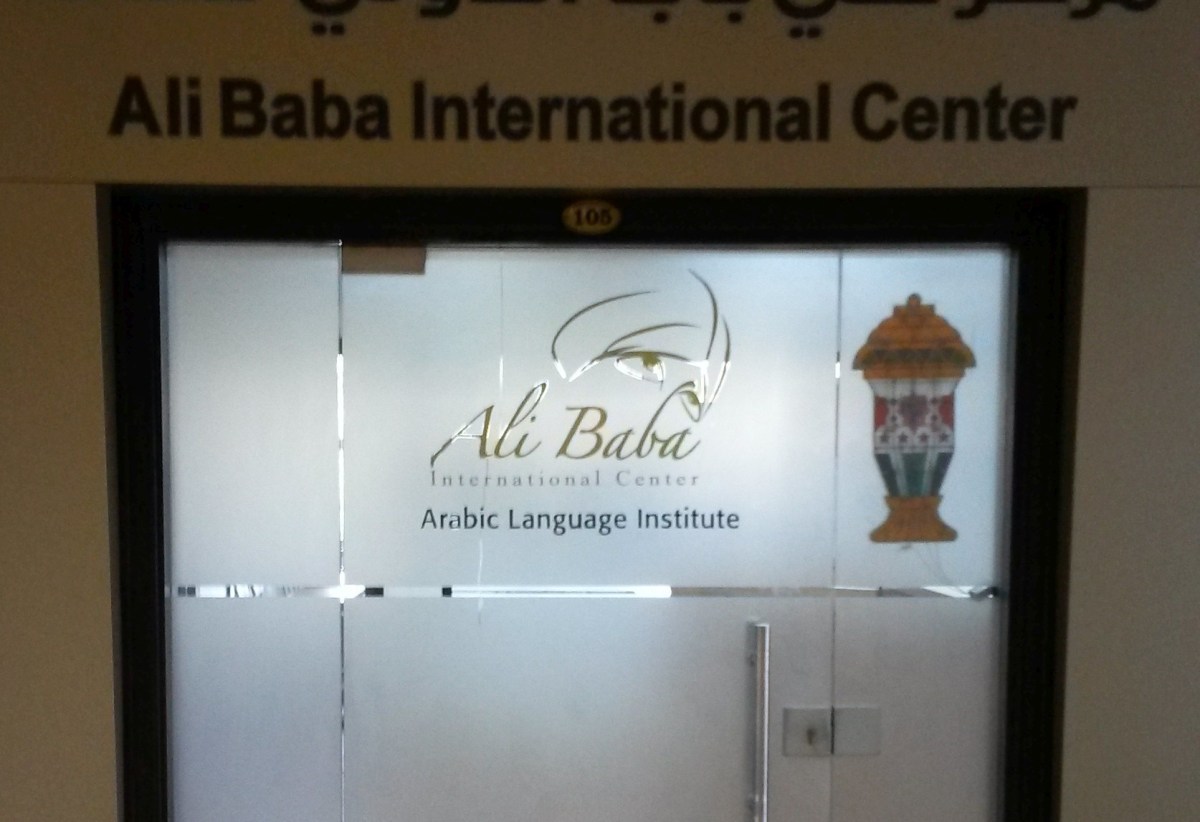
Ali Baba

The Ali Baba International Center focuses on learning both German and standard Arabic.

Ali Baabaa is not very well known, which is probably why I was only able to study here for one month.  After that there were no more students of intermediate level.  Their busy period might of been  during the summer and the month of January.

For a private institute, I was quite impressed.  There was no bored director greedy for US dollars or playing games with the student’s level.

Perhaps more importantly, the teachers were very polite and clearly skilled professionals (or at least trying to appear as such).  In fact, the teaching style was similar to that of the TAFL Center in Alexandria, but without the abuse and discrimination.

Yes, initially, the name made me laugh too, but in the end the joke was on me. This really is a genuine place for the serious student of Arabic.

Although I only studied here for four weeks, I gained a lot more than I expected, much more than from the so-called university opposite.

Worst of both worlds

My friend, JQ (being proud to be retarded), invited me to Jordan, arguing that that their variety of Arabic is closest to the modern standard version (or classical Arabic; later I learned that his MSA or classical Arabic was deficient – perhaps as bad as his English). However, I had no reason to travel to Jordan as I did not know a good centre where I could study the Arabic language. In the end, I chose to start my journey in Alexandria, Egypt where I would learn the Egyptian dialect, which made sense to me as the Egyptian dialect dominates the Arabic-speaking world.  However, JQ had an operation on his eyes and since Jordan is almost next door to Egypt thought I should make a short trip there.  I first met him back in 2009 and we had stayed in touch almost ever since.  I suppose visiting him seemed like the moral thing to do. When I arrived in Jordan, my friend wanted me to stay for longer, but (due to past experience) I was afraid of the people.  However, he convinced me that I should stay longer and he promised to take care of me.  In the end, due to medical treatment, I had no choice but to stay a little longer. My Jordanian friend started to refer to me as his elder brother, but in the end, I realized that I was being used.  All he wanted, was for me to spend my money in Jordan and to tell him that Jordan is better than Egypt. His friend, HS (also proud to be retarded), managed to convince me that it was a waste of money to book an additional ticket to fly home and that it was logical to learn the language from the country where the people speak it.  I replied that there was an issue with this. In what centre would I study in?  Also, she had complained about daily life in Jordan and so why would I want to spend any time here.  She then suggested that since I had not spent Ramadan in Jordan, then I should do so. (As if it made any positive difference to a foreigner). Trouble was that I never found a centre that could do justice to my education (until it was too late).  My friends were actually unconcerned about my education or my future career.  And my wealth was diminishing very fast.  True, I worked in Jordan too, but that was not enough to sustain the money I’d saved previously.  Then I also had to make a choice between work and study.  Most times, it was not possible to do both at the same time.  Had they told me about a good centre to study in, which also would not break the bank, then Jordan could have worked out for me (considering all the time I had spent there).  But they did not, but simply kept referring to a hypothetical centre… Furthermore, when I told my Jordanian friend (JQ) how one of the teachers at the TAFL center (in Alexandria) had abused me, he almost started laughing (as in – you want to return to those bitchy racist people, who do not even give you your rights as a student in their centre).  And that’s all he did.  Then I felt silly about the prospect of returning to Egypt, but where would I study?  I did not come to Jordan for a holiday or for work. To stay in Jordan I needed clothes for the winter.  It does get very cold in Amman.  While the summers are like that in Asia, the winters are like that in Europe.  Some of my clothes had been damaged in Alexandria and some I had been forced to leave behind.  My Jordanian friend took care of that by recommending poor-quality or expensive shops (for example in City mall where they were usually both poor-quality or expensive). It’s almost like some people are ashamed of central Amman even though they know that the best deals exists there and not in City mall.  Perhaps the reason being that it looks more like a traditional high street.  It is also the sort of place where you feel that you have arrived in the Middle East where you do not find McDonalds and Burger King (as opposed to Western Amman). Eventually I was fortunate that one of my teachers at Ali Baba informed me about shaaria itale near central Amman, which is a great place for buying shoes.  Closer to Western Amman, is the souk sultan (behind Medina street near the Jordan University). My friend also once recommended a restaurant (in City mall) where I got food poisoning and then suggested that I have a weak stomach.  Eventually, I realized it must have been the Shaninah (yogurt type drink) this time.  I could share that thought with him, but then, as I later realized, everything in Jordan was good (he wanted me to believe). He also said we would visit sites, e.g. hiking, etc, but we never did. There were other let-downs too… It was a confusing time for me.  On one hand, I wanted to return to Egypt to finish my studies and return home, but on the other hand, I felt traumatized by the prospect that a teacher might wish to abuse me after welcoming me to the centre.  In addition, I still feared the illness I had suffered as a result of cat flea bites and I became really hung up on accommodation issues.  I also remembered how the GP and the skin doctor in Alexandria were not able to cure me and gave me somewhat mis-leading advice (not purposely of-course).  Consequently, my condition turned (unbearably) worse. My Chinese contact in Alexandria added another level of complexity to the story, by suggesting that Jordan is better in teaching Arabic and that I should consider an alternative location such as Tunisia, which had become a stable democratic nation (or so we thought).  In his opinion, Egypt was volatile and just was not worth the investment. I had planned everything for my return to Egypt, but the level of anxiety I was experiencing was over-whelming!   To the point my body was shaking at the time (whenever I sat down in front of the computer to book a ticket).  Sometimes I’d have negative images of biting insects going through my mind.  I could not call my Jordanian friend as he had stopped talking to me (see below) and out of embarrassment I would not call my friends nor my mother in the UK (but I should of).  I had already discussed the pros and cons of going to Egypt and was not sure what else to say to them.  In the end, I did nothing. On a previous trip to Jordan, I had become concerned about the racism (of some of the West Bank Jordanians) and xenophobia (of some of the East Bank Jordanians), but my friend had assured me that this issue was really from a minority of people.  Due to his upbringing, in which he and his brothers had suffered discrimination from some of his own relatives on his father’s side (by virtue of his mixed heritage), I did not think he could be racist.  His father was of East Bank origin (‘Jordanian’) whereas his mother of West Bank origin (‘Palestinian’).  I really thought he was different and possibly unique.  Partly through him, I had a positive future view of Jordan.  In fact, whilst in Amman I felt like I was someplace in England.  It seemed like an organized city as compared to Damascus. However, over time it became clear to me that my friend was a nationalist and worse: our friendship was secondary to his nationalism.  His good treatment towards me may have been (and his bad treatment towards me may also have been) for a higher cause (in his mind).  Perhaps studying Arabic in Egypt was, for him, a rejection of the people in Jordan. Another annoying thing I experienced in Jordan was that some of the East Bank Jordanians would tell me that they were the original people and then the others arrived and things got complicated.  A strange claim since the first administration of the first king, Abdullah I, actually included Syrians, Palestinians, etc.  Also, some of the Circassians would say that before they arrived, Jordan was barren and lawless and that they started the foundation of the country and that it was through them that the kingdom was established.  Also a strange claim since some of the Palestinians say that before they arrived, there was nothing but desert and that they built Jordan! In actuality, initially, the King’s ambitions extended to all of Palestine and Syria.  He was interested in ruling over a multi-ethnic and multi-faith society, but the super-powers, at the time, had made other plans. Furthermore, when I looked around, what I saw were Egyptians doing the building work.  Their situation was similar to how the South Asians dominate the construction industry in Dubai, but with better work conditions I think.  Or at least it’s not common for them to work under the Sun when it is 50 degrees Celsius (as they do in Dubai) or have their wages withheld – almost indefinitely. Another one I heard was that Palestinians and Jordanians speak a dialect different from each other.  In my experience, yes and no.  There is also a difference between town and country, north and south, so it is not that simple.  I wonder what the Circassians speak? Some also claimed that the Jordanian or Palestinian colloquial is closest to the modern standard or classical Arabic.  Even if it is true, any beginner to Arabic will never understand a Jordanian conversation. Even once I was told that Jordanians and Palestinians speak modern standard Arabic.  They definitely do not.  Even mothers speak to their children using colloquial. I think there are some people in the world who need to talk less and work more for everybody’s benefit (as well as their own).  They should also stop making false claims and deliver on their promises. My friend asked if I wanted to marry a woman in Jordan and I said that a long time ago I use to know some nice girls in Jordan and once thought that this is how I’d want my future daughters to be (sweet, humble, hard-working and committed to traditional values), but because of racism I would be wasting my time trying to marry an Arab lady.  However, he claimed I was mistaken and eventually I believed him. I also told him that I reckoned I might have a better chance in Pakistan and in fact was thinking of studying Urdu there after I was done with the Arabic studies (never happened).  Also, that I wanted to travel to China to learn Chinese and that I really missed my Turkish friends and wanted to learn Turkish (none of this ever happened). My Jordanian friend also introduced me to the concept that marrying an Egyptian girl is a bad idea.  The analogy he gave is a woman standing in the middle of a room screaming her head off.  I told him that he was wrong to say this as he was generalizing about a population of a 100 million.  Furthermore, I told him that I found their personalities very interesting, but had not spent sufficient time in Egypt to understand the people properly.  I found them very diverse and they were still a mystery to me. On two occasions, my supposed Jordanian friend stopped talking to me.  The first time for a month and the second time he has not spoken to me since.  At the time, I could not figure it out and somewhat blamed myself.  More recently, I realized that just before the first time I had been discussing the possibility of returning to Egypt.  Whereas the second time, I really did travel to Egypt. Since my so-called Arab friend was of half-East Bank (Jordanian) heritage (on his father’s side) and half West Bank (Palestinian) heritage (on his mother’s side), I once joked with him, but I meant it, that he had the best of both worlds.  Furthermore, that he could be a maker of peace and unity between the Arabs.  However, eventually, it appears his only interest is pretending that there is no difference between Palestinians and Jordanians, whether that is in ideaology, ethnicity, language or culture, and had no interest in thinking of Egyptians as equals to his own ‘people’.  In the past, he used to prefer his Palestinian relatives, but now claims his Jordanian relatives are awesome.  No doubt there has been an upgrade here, but I cannot tolerate his racism (quite prevalent amongst West Bank people in Jordan) and xenophobia (quite prevalent amongst East Bank people of Jordan), especially as it has impacted my own well-being.   A true friend would of protected me from both retarded and negative forces. As if my friend in Jordan was not bad enough (or real enough), then when I finally did return to Alexandria, I soon realized that my Chinese ‘friend’ was also out to use me 😦 Is that what friendship is all about (exploiting each other)? Without a doubt, I had some great experiences in the Middle East too, but 30,000 dollars later I sometimes wonder why I was really there?  It appears that over time, and going from one crisis to another, I had forgotten my original priorities.

إذا رأيت نيوب الليث بارزة … فلا تظنن أن الليث يبتسم

If you saw the fangs of the lion showing out, never think the lion is smiling. Do not be deceived by looks.  (https://www.quora.com/What-are-some-beautiful-Arabic-sayings-and-their-meanings).
Mr Toxic

The conversation started with why, in the end, I had not studied for a masters in history.

Despite my passion for this subject, the answer for me was simple: the banking crisis of 2008 and the subsequent personal financial loss in the United Arab Emirates (UAE).

Apparently, I had misunderstood the situation.  Qadir Ali argued that studying the Arabic language in Alexandria would lead to a job and a better career.  He also tried to convince me that I am not the engineering type and that my degree in computer science was a mistake.

The opposite is true.  By following his plan, I lost more than three years and was over 100,000 dollars (financially) worse off.

When looking back, it is very clear that one cannot trust most of what he says.  Was a liar, is a liar and probably always will be a liar.

The truth is that Qadir Ali only joined a FANG company (Facebook, Apple, Netflix, Google) after attaining a 1st class Arabic (and Islamic studies) degree from the School of Oriental and African Studies (SOAS) and not from Alexandria, but this was not before being unemployed for six months and then working as a sales-type for a hardware company, for a year, based in some village near High Wycombe.

While encouraging me to leave an IT career, I later learned, he was studying  the Japanese language and Machine Learning; perhaps eyeing a Google (Alphabet) career in Japan?

As late as 2013, I was having doubts about his plan for me, but he told me to man-up and compared me to a mutual friend (of an expat family from UAE) who had studied eastern history exclusively with English texts (hence, in his opinion, a loser).

He also tried to convince me that I need to do at least four years of Arabic in order to study history at SOAS.  Qadir Ali made this claim despite knowing that according to the professor (the convenor of the history module, which I was interested in) two years of Arabic would probably be fine (and all I would probably need is a few months revision).  He also kept it to himself that I could purchase the actual course Arabic texts from the SOAS bookshop, (which I could focus my attention on, but I guess that would lead to a more successful outcome and that is not really what he wanted – as became clear later).  In the end, he even recommended I do a degree (3-4 years) in Arabic at Leiden university.

Qadir Ali misled me about Alexandria.  For example, he promoted the library as open 24-7 when actually it’s open only until around 5pm.  He described the city as the most beautiful place in the Middle East, but failed to mention the mountains of rubbish (that you will come across every 1000 metres).

He claimed that the programme in Alexandria was superior to that in SOAS and that the SOAS graduates could not speak Arabic.  He should know (I thought), he studied in both places.

Before going out there, he insisted I study Egyptian Colloquial Arabic (ECA), but after I enrolled for both Modern Standard Arabic (MSA) and ECA, he explained that the colloquial course is rubbish and that I needed to sit in the smoke-filled coffee houses to learn the dialect (therefore, thanks to him, 850 US dollars immediately wasted in fees to a racist institute).  He also wanted to send me Egyptian dramas (perhaps illegally downloaded), suggesting this is the way to learn. 

Why then did he tell me to enrol at the TAFL center in Alexandria? 

What was his motivation for deceiving me?  Was he bored with his translation career.  Is Dublin, Ireland not as exciting as he imagined?  Did it anger him for not being able to find a job in London?  Or does he regret not following a different career path; one that would sooner lead to a job in his hometown of Newcastle?  Or was he fed-up of sharing apartments with strangers and not being able to afford a one-bed flat and save money at the same time.  Or was it for his retarded ego?

With hindsight, I should have left him from day one.  Back then (five years ago), Qadir was often abusing people, but perhaps we felt sorry for him because he started out his student life in London by sleeping on the buses.  I also thought he genuinely wanted to be my friend and (much) later (on) wanted to help me sort out my career.  I use to think that his rough side was due to his upbringing in Newcastle (never been there myself), but this was a misconception.  He was simply aspiring to be a fountain of lies.  I guess his definition of friendship was different from mine.

After Qadir returned from his year abroad in Alexandria, I was excited to meet up with him in Hampstead Heath (where is was staying), but he had an abusive attitude (that I had to correct before continuing) and I found him with a cigarette in his mouth, which I ignored (perhaps at my own peril), which I did not expect for a person who did not even want to go to the cinema with us.  Was it really because he could not afford such entertainment, (but then how could he afford cigarettes)?

Another omen was when Qadir seconded the opinions of the mixed-heritage guy from Jordan, but later criticised him in a phone-call to me (as a way back into my life – I now realise).  Much later, once he was confident again in his use of weasel words, he justified the Jordanian mixed-heritage guy’s retarded arguments or downright lies.

What did I do to deserve this?  Had I not been a friend?  He use to brag about being working-class and perhaps, for a while, I saw myself in him (not the bragging bit) – working my hardest to get out of poverty and then to culture myself and help others.

My father once said, that (as a child) he always preferred the poor over the rich.  Perhaps that only works in the countryside or perhaps times have changed.  Whatever the reason, now I know from experience, you cannot judge a person by their economic background.

At least a couple of times, I paid for his lunch/dinner and encouraged him to study hard and not concern himself with the lack of motivation of his rich-kid classmates, which he was becoming increasingly obsessed about (whose parents were always going to sort them out with money or a job).

I even invited Qadir to my parent’s home where he enjoyed my mother’s cooking, and my late father had sincerely welcomed him.  However, none of this appears to have made a difference.

Three years from now, he will honour me with impoverishment and a ruined academic (and working) career.  I suppose we should expect no less from somebody who aspires to be a munafiq.

The hypocrites will be in the lowest depths of Hell, and you will find no one to help them (4:145).

Fountain of lies

I use to know a Dajani of Jordan (with Palestinian and Circassian heritage), who I think had spent more time outside Amman than inside, including Egypt, Morocco, Canada and the United Kingdom.  In fact, he eventually married a lady in the UK while studying for a masters at the School of Oriental and African Studies (SOAS).

I use like the Dajani (for being knowledgeable in humanities), but he once explained to us that the Jordanians (of east bank origin) are not really Muslim.  For instance, according to him, there was once a street protest and the police arrived to contain it.  Behind them were intelligence.  The demonstrators were using religious chants.  Whereas on the police side, cursing of the prophet of Islam could be heard.

The last time I met him, he argued (with me) that learning Arabic only takes around six months!  Of-course he was lying and for this reason as well as pressuring me to socialise with his friends in Jordan, who were always speaking English or, if I was ‘lucky’, speaking colloquial.  However, colloquial is not normally taught in Jordan so I never understood, except the bit when it’s clear that they hate Wahhabis, which after hearing many times sounds the same in every language.  Also, always trying to get me to attend Thursday Sufi dance sessions, and something they called dikr with bikr.  Eventually, I gave up being his friend.  I was annoyed; I felt that rather than be a true friend, he attempted to weasel and I did not like that one bit.

How can a true Sufi behave like this?  However, with hindsight, he was a saint compared to somebody else we knew.

Qadeer Ali, who studied Arabic with/and Islamic studies at SOAS, and (despite supposedly a friend) contributed to the toxic environment (described above).  Qadeer Ali also encouraged me to dikr with bikr, arguing that it is beneficial for my learning of Arabic, (but not for his obviously).  Probably Qadeer did not want to attend himself (perhaps he only did it so he could get free accommodation with the Dajani, who could be very generous) and felt it only fair that I should force boredom upon myself also.  He finished off with giving me a handwritten copy of all the verb conjugations.  I already had this in my books, but he insisted that I take it as a souvenir.  He should have given that to the guy who failed his Arabic (see below).

In their hearts is a disease, so God has increased them in disease, and for them is a painful punishment because they used to lie (2:10).

In addition, an Arabic-turned-history-turned-media student also joined in the frenzy.  He always had a chip  on his shoulder; I’m guessing because he studied at Ibn Jabal, but failed the first year of BA Arabic at SOAS and then aspired to annoy me. 

Admittedly, the Dajani had much better manners (on most days) than the two Brits put together.

Actually, originally, I really wanted to be his friend (of-course I’m only talking about the Dajani), but I later realised that he always had another agenda and the lies just pissed me off.

Sure, I’m not exactly perfect myself, but I don’t make it my life’s mission to recruit people, by any means.