Some of the Worst TAFL Schools Worldwide

Listed here are some of the worst language schools for Arabic language training worldwide, i.e. the TAFL centres to avoid (from better to worse):

Alexandria Centre for Languages (ACL). Only come here within a group organised by your university. Even then, do not have high expectations and forget what you saw in the brochure (it’s outdated) or heard in the presentation.

SOAS Language Centre (not to be confused with the SOAS degree/diploma programmes, which are very good – perhaps the best). Choose the language centre if you want to be continually reminded that nobody speaks modern standard Arabic or if you just want to learn random vocabulary and grammar. Taught by foreign masters/PHD students (or former students) of the university (who are primarily native Arabic speakers, not teachers). However, sometimes you get lucky. May help to run a background check on the teacher before enrolling.

– Arabica Institute (Ibn Jabal). Pay them lots of money to hear why they think School of Oriental & African Studies is bad, from a teacher who almost failed his SOAS Arabic degree; who lectures by reading from a script, i.e. the useful book you can download while you are student, but can never buy as a book.

UJLC, Jordan university. You are better off working in Dubai and learning Arabic part-time. Permanent contract teachers only get jobs here if they have a connection. Consequently, they are too lazy to teach and waste your time with a language partner scheme. Also, they are proud to be retarded.

TAFL Center, Alexandria university. If you do not mind a premature death, then this is the place for you. This place might work for you if they consider you Egyptian or if you are from the British embassy (then, while bowing down, they will probably forget to remind you that you destroyed their country and might even celebrate your monarch’s birthday). Almost forgot to mention the racism and discrimination. For more details, read on.

In 2014, I was a complete beginner to Egyptian Colloquial Arabic, yet the director (Dr Lana Habib) put me in a higher level, explaining that I was super smart.  As a consequence, I understood next to nothing during those classes and my reservations were ignored.  Later during the term, she obliged me to attend (just myself) a conference, in Colloquial Arabic, at the French Cultural Centre, claiming that I was the most suitable student. 

During the term, one of the colloquial teachers was suppose to give me extra tuition (in order to catch up with the others), but she was probably still hung up with me having eaten at a Syrian restaurant.

In 2016, Dr Lana Habib misinformed me about what programmes and levels were available at the TAFL Center. Consequently, I wasted time considering unsuitable programmes and courses, which she had encouraged me to join.

The director tried to confuse me about my level of Arabic. Eventually, I ended up enrolling in another centre at the wrong level and being cheated out of my money.

I was insulted by a teacher during a class in the TAFL Center. She questioned my British identity and laughed at my face. Then encouraged another student to laugh with her.

There appeared to be some degree of hostility towards me, perhaps because I ate in a Syrian restaurant (at the invitation of others) or that the teacher believed Britain was responsible for the destruction of Egypt.

All in all, my time was wasted in Alexandria. When I complained to the TAFL Center, instead of resolving the issue with the teacher, the director sought to hide suitable programmes and courses that I could benefit from and annoy me until I left the centre.

Alexandria Centre for Languages

After visiting Pharos university I came across the Alexandria Centre for Languages (ACL) where finally I found out what happened to the SOAS students (School of Oriental & African Studies, University of London).  Apparently, since 2014 or earlier, for their year abroad, they had a choice between ACL, an-Najah university in Palestine and Qasid in Jordan.

The SOAS students appeared to be a lively bunch and on the first day spoke to me in Arabic, which naturally inclined me towards them.  I worked out a deal with the director, Magda Abou Youssef, that I could try out the course for one week, which I paid for, and then decide whether to join the SOAS programme or not.  I also took the placement test.

Continue reading “Alexandria Centre for Languages”

Language Center, Jordan University

Finally, I had my last examination for level 5 at the Language Center, University of Jordan (UJLC).   The teachers are okay and the style of teaching is not bad.  However, I was really bored.  It’s possible that I even loved the students in my class, but they did not speak Arabic.  Some of my previous class-mates had been more advanced.  Also, most of the grammar was the same as before or was too easy.  I started to lose concentration and felt like I was going backwards.

To stop myself from dying of boredom I agreed to take on the language partners of my Chinese colleagues (as they were majoring in Chinese and English) and, in fact, not only did they make my remaining time more interesting, I also benefited from them.

Generally, I had found the language partner scheme a waste of time.  It really depended on who you ended up with.  Most times I spent chasing my language partners up (the ones allocated to me by UJLC) and agreeing to appointments that they could not honour.  They usually lost interest after the first week.  One of the better experiences I had also did not turn out very well when his friends did not think I was a real Muslim (since for them, that was the real reason I was learning Arabic) and started to preach to me because they felt sorry for me.

However, the language partners of my Chinese colleagues were more enthusiastic, professional, committed and helpful.  On the other hand, there was only so much I could benefit from them and them from me (as they were suppose to be focusing on their own studies and they were already actually quite smart with English and were asking some difficult questions).

What was I doing there?  For crying out loud, I paid for an Arabic course!

Therefore, I really wanted to move up to level 6, but it seemed almost impossible, even though I scored 65 in the placement test that made me eligible for level 8.
The new director, Fatima Omari, misled me and her colleague shouted at me when I asked about changing.  According to the director, the grammar in level 6 is the same as the grammar in level 5.  Either she was lying or this is the most retarded centre I have ever tried to study in.  There was also discrimination with regard to choosing a level.  Some people were given one day (for example, myself) whilst others were given ten days.

They were simply too lazy or too arrogant to make the change!

And I think my teachers did not want to confront her.  Eventually, they had a chat with her, but she became a bit unstable!!

The following morning she was rude to me.  She demanded that I write a report about the differences between level 4 and 5.  How the hell would I get time to do that and it was not my job anyway.  They were suppose to be teaching me Arabic.  That’s what I paid for.

Enough was enough!!!  I decided to listen to the advice of the Chechen guy and complain to the president of the centre (if there was such a thing, as nothing was very clear or consistent in this place).  It’s a long story and there was no positive result.  Eventually I did complained to the president of the centre (showing him the list of grammar that I had already learned, actually 90%).

Had I known the president of the centre existed I would have complained to him much sooner.  Hopefully, a lot of lessons learned here.

It had been quite a stressful and depressing experience.  Thought things had changed here for the better, but clearly for the better and for the worse.

Undoubtedly, some people in the centre hate me, but the main change was that the director was no longer confrontational.  She was also asking what she could do to help, but it was actually too late and she already ignored my teacher’s suggestions and was uninterested in what I wanted and what my rights were.

So it was just a month more of boredom, then examinations.  Or so I thought…

In the last week of term, the grammar teacher asked me why I had complained about her to the director (saying that she is a bad teacher) and I was so surprised to hear that.  And I explained how all I’d said was that I’d already studied most of he grammar and wanted to go one level up, but that the director was indifferent to my request even though it was my right (I had scored more than high enough in the placement test).  The teacher said that she believed me and offered me coffee.

There seemed to be no end to this saga.  Admittedly, these were not my favourite teachers, but outside of class they were likable (decent perhaps).  I did not actually want to leave their classes (and they were really trying to help me), but I needed to (learning was the whole point of being there and paying 1800 USD).  I also liked the students in my class, but that not the point.  I started to feel as though I was going backwards and losing interest in my studies, was not going to the library and began loitering more.  Unfortunately also, as time went by, I felt my relations with my teachers were really straining.  Of course, it was just suppose to be professional, but it still did not feel right.

I just could not believe that such a retarded issue could not be fixed.  What could possibly be the motivation for this behaviour?  Is Jordan really the Hashemite Kingdom of Boredom?

One thing they do right here in Jordan university is a conference known as the Amman Message.  They claim that Islam calls for tolerance and unity and that true Muslims are totally against terrorism.  They make the challenge that you will not find even one student (of University of Jordan) in the faculty of sharia who, after graduation, joins Al-Qaeda separatists in Iraq and Syria.  Their point being that extremist groups recruit from those who are actually ignorant.

I think the Language Centre should also understand that their prophet said: “Allah curses the thief who steals (even) an egg” (Bukhaari).

Unfortunately, this experience has left me with the feeling that Jordan is a waste of time and waste of money for the student of Arabic.  However, with not many choices of location, what can you do?

Always thought I’d end up returning to Alexandria, but the character of some of the people who worked at the centre there was in question.  With hindsight, getting abused whilst really studying Arabic and then being able to go home on schedule (satisfied with what I had learned) seemed preferable to what had happened in Jordan.  Some of the staff here were no better.  Perhaps I had mis-judged Alexandria?  Perhaps it was just all a mis-understanding!

On the other hand, I also believe that Jordan has potential, but that the corruption is holding the hard-working and talented people back.  Sometimes I feel sorry for them.  It is all about who you know and not what you know.  There is hardly any meritocracy.

Jordanians have also told me that everybody wants to be a general without being a solider first.  Consequently, there are too many cow-boys and not enough Indians.

Actually, my biggest regret was that I did not return to Egypt, though it just did not seem like a choice anymore and I knew no other useful centre.  Cairo still was unexplored territory for me, but it seemed (perhaps wrongly) too plain scary (at the time).  Much later, I heard that the language centres in the capital of Egypt are quite professional and well-known for their high standards, as opposed to those centres existing elsewhere, but perhaps I will never really know.

The only other location I knew at the time was Tunisia, but the security situation there was starting to look worse.


(Image Copyright Andres Rodriguez | Dreamstime).

The Narcissist

In Jordan I experienced a number of exploitative relationships.  With the case of a girl from China, I would often wonder ‘what the hell was I thinking’.

I first met this girl back in 2009 and was somewhat intrigued as she was a Turk from China, which seemed unusual.  She also seemed very quiet (which I now think is because she did not know any English).  There were hardly any Chinese in Amman at that time and so I said I’d teach her English if she taught me Chinese, but it never happened.

Over time I saw her bad character.  At the beginning I use to feel sorry for her as she talked a lot about how the Chinese government oppresses her people.  Regarding that, I remembered hearing something (back in London) on the news (CNN I think).  Apparently, they were not allowed to fast in the month of Ramadan!

After she had been very rude to me I saw no real friendship and started to realize about how she intended little in the way of improving the situation in China.  That she was well and truly oppressing herself with a form of nationalism.  China had become, by this time, the number two economy in the world.  Something to make the most of I thought.

In Egypt, the Uyghurs I met (as the Turks of China are known) were generally polite, well-mannered, worked hard and positive about life and other people, including Chinese people.  Sure, there were issues at the state level, but then the regular Chinese also criticized their government a little.

I met a lot of Chinese, but had no idea that some of them were Uyghur until one of them met me in the street one day and introduced herself properly (in almost perfect English).  Until then I could not tell the difference, although, by that time (2014), I had learned about them as part of a course on the history of China.  So in Egypt, over time, I really started to like the Uyghur.

As for the one in Jordan, what was her problem?

After I returned to England (2010), I did not talk to her much, but later she started to tell me about her problems (via Facebook) and I started to see some commonality between us.

A few years on, I found myself in Jordan again.  Due to medical treatment, I was stuck there and after a re-union with some former students of the language centre, I learned (from the Korean) that the Chinese Turk was still in Jordan and had stopped talking to her after the Korean had been unable to attend a meet-up.   Felt I’d better let her know that I am in Jordan, lest she also become angry with me too.

So I did let her know and she started to call me and as time went on the calls became longer and longer (and in English).  Being in the same city, but only communicating via the phone became tedious for me and I suggested that we meet.

We met not far from her Arab foster family and we ended up sitting there for a while (and talking in English of course).   At the end of it I felt quite guilty.  Here was a naive young lady who had suffered much stress and depression in the last few years.  Even I noticed the white hairs on her head and she was only twenty-five years of age.  Had I been selfish?  Was I only meeting her because I felt isolated in Jordan?

I wanted to help her and in the medium term even suggested I’d be her older brother if she wanted.  I had already re-acquainted her with our Korean friend (and former colleague) and that had made her glow a bit more 🙂  Thought I was doing something right for a change.  However, as soon as the anti-Chinese rhetoric started, I started to feel like I might have actually done something wrong.

From the way she talked, it started to look like she was suffering from severe depression, may be bipolar or something of the sort.  She even made statements such as having the wrong genes or the wrong family background or born with the wrong nationality, etc.

I started to wonder; to what extent was the people’s republic of China responsible for this girl’s extreme outlook on life?  Perhaps the Chinese government ought to revise its policy towards the Uyghur and other ethnic groups.  Their current policies were clearly not working and brewing something very unhealthy.  Or perhaps this individual was merely narcissistic?  I was never certain.

She was a little obsessed with looks (her own, her tribe and other people) and asked me at least once if she was beautiful.  Stranger than this, she would at times sound very religious and talk the talk.  Other times, she would sound very ungrateful and at least once she sounded blasphemous!  I tried to advise her, even about the racism, but it made no difference.

She was studying a degree in Arabic at WISE university and wanted to start looking for a job before she graduated.  So I helped her with her CV and setting up a profile on various job and career sites.  She wanted more, she wanted me to teach her IT in exchange for her teaching me Chinese.  However, I wanted to enroll on a calligraphy course, a Turkish language course and an Arabic colloquial course and did not have time to do more.  That did not go down too well with her…she even started making preparations.

Unfortunately, our friendship became a little abusive and immature.  She often asked what sort of woman I wanted to marry.  I answered X, Y and Z and she took that to mean herself.  I clarified that ideally I wanted to marry Chinese, which was true to some extent, but actually the race mattered not as much as the character, so any girl would do – even Korean or Arab.  She even asked if I wanted to marry her, but added that I was not her type.  I replied that I was not interested, but even if I was, I would not, since her hatred for Chinese was bad for business.

Six months later (after I had become tired of her racist tendencies and her negativity about Jordan and of Arab women) she called me and demanded that I speak to her in English when talking about personal stuff (which was always the topic of the day), otherwise she would hang up!

I’d been struggling with locals and foreigners trying to get me to teach them English for free.  As a defense, my mind was often, with limited grammar and vocabulary, in Arabic mode, which I could not always control and in the long run may have contributed to brain damage, (but that could of been more because of my bad experiences in the retarded language centres).

On average, I was harassed at least once a week and met a new harasser once a month.

For this reason, my mind was in Arabic mode when the Chinese-hating Turk telephoned me.  As a result, she really did hang up.  After that we had a bit of an unfriendly exchange (by SMS/TXT) and then the silence.   It was difficult at first (probably because I was far from home, family and (my real) friends), but then I felt relieved:   freedom from her corruption at last!

I could not believe that I had put up with her for so long, when I really owed her nothing.  Why on earth had I contacted her in the first place?

Later, the other reality also dawned on me.  How would our mutual fun-loving, chilled-out Korean friend react?  In the long term she stopped talking to me too and I felt sad at first.  Was that because she was the only friend I had in Jordan?

Later, I realized that they were almost as bad as each other, tired of the Arabic language and culture and simply wanting to learn English; migrate to the UK or the USA and in love with money.  This is what drew them to me.

Sometimes it feels like the noble act can also be foolish!
Worst of both worlds

My friend, JQ (being proud to be retarded), invited me to Jordan, arguing that that their variety of Arabic is closest to the modern standard version (or classical Arabic; later I learned that his MSA or classical Arabic was deficient – perhaps as bad as his English). However, I had no reason to travel to Jordan as I did not know a good centre where I could study the Arabic language. In the end, I chose to start my journey in Alexandria, Egypt where I would learn the Egyptian dialect, which made sense to me as the Egyptian dialect dominates the Arabic-speaking world.  However, JQ had an operation on his eyes and since Jordan is almost next door to Egypt thought I should make a short trip there.  I first met him back in 2009 and we had stayed in touch almost ever since.  I suppose visiting him seemed like the moral thing to do. When I arrived in Jordan, my friend wanted me to stay for longer, but (due to past experience) I was afraid of the people.  However, he convinced me that I should stay longer and he promised to take care of me.  In the end, due to medical treatment, I had no choice but to stay a little longer. My Jordanian friend started to refer to me as his elder brother, but in the end, I realized that I was being used.  All he wanted, was for me to spend my money in Jordan and to tell him that Jordan is better than Egypt. His friend, HS (also proud to be retarded), managed to convince me that it was a waste of money to book an additional ticket to fly home and that it was logical to learn the language from the country where the people speak it.  I replied that there was an issue with this. In what centre would I study in?  Also, she had complained about daily life in Jordan and so why would I want to spend any time here.  She then suggested that since I had not spent Ramadan in Jordan, then I should do so. (As if it made any positive difference to a foreigner). Trouble was that I never found a centre that could do justice to my education (until it was too late).  My friends were actually unconcerned about my education or my future career.  And my wealth was diminishing very fast.  True, I worked in Jordan too, but that was not enough to sustain the money I’d saved previously.  Then I also had to make a choice between work and study.  Most times, it was not possible to do both at the same time.  Had they told me about a good centre to study in, which also would not break the bank, then Jordan could have worked out for me (considering all the time I had spent there).  But they did not, but simply kept referring to a hypothetical centre… Furthermore, when I told my Jordanian friend (JQ) how one of the teachers at the TAFL center (in Alexandria) had abused me, he almost started laughing (as in – you want to return to those bitchy racist people, who do not even give you your rights as a student in their centre).  And that’s all he did.  Then I felt silly about the prospect of returning to Egypt, but where would I study?  I did not come to Jordan for a holiday or for work. To stay in Jordan I needed clothes for the winter.  It does get very cold in Amman.  While the summers are like that in Asia, the winters are like that in Europe.  Some of my clothes had been damaged in Alexandria and some I had been forced to leave behind.  My Jordanian friend took care of that by recommending poor-quality or expensive shops (for example in City mall where they were usually both poor-quality or expensive). It’s almost like some people are ashamed of central Amman even though they know that the best deals exists there and not in City mall.  Perhaps the reason being that it looks more like a traditional high street.  It is also the sort of place where you feel that you have arrived in the Middle East where you do not find McDonalds and Burger King (as opposed to Western Amman). Eventually I was fortunate that one of my teachers at Ali Baba informed me about shaaria itale near central Amman, which is a great place for buying shoes.  Closer to Western Amman, is the souk sultan (behind Medina street near the Jordan University). My friend also once recommended a restaurant (in City mall) where I got food poisoning and then suggested that I have a weak stomach.  Eventually, I realized it must have been the Shaninah (yogurt type drink) this time.  I could share that thought with him, but then, as I later realized, everything in Jordan was good (he wanted me to believe). He also said we would visit sites, e.g. hiking, etc, but we never did. There were other let-downs too… It was a confusing time for me.  On one hand, I wanted to return to Egypt to finish my studies and return home, but on the other hand, I felt traumatized by the prospect that a teacher might wish to abuse me after welcoming me to the centre.  In addition, I still feared the illness I had suffered as a result of cat flea bites and I became really hung up on accommodation issues.  I also remembered how the GP and the skin doctor in Alexandria were not able to cure me and gave me somewhat mis-leading advice (not purposely of-course).  Consequently, my condition turned (unbearably) worse. My Chinese contact in Alexandria added another level of complexity to the story, by suggesting that Jordan is better in teaching Arabic and that I should consider an alternative location such as Tunisia, which had become a stable democratic nation (or so we thought).  In his opinion, Egypt was volatile and just was not worth the investment. I had planned everything for my return to Egypt, but the level of anxiety I was experiencing was over-whelming!   To the point my body was shaking at the time (whenever I sat down in front of the computer to book a ticket).  Sometimes I’d have negative images of biting insects going through my mind.  I could not call my Jordanian friend as he had stopped talking to me (see below) and out of embarrassment I would not call my friends nor my mother in the UK (but I should of).  I had already discussed the pros and cons of going to Egypt and was not sure what else to say to them.  In the end, I did nothing. On a previous trip to Jordan, I had become concerned about the racism (of some of the West Bank Jordanians) and xenophobia (of some of the East Bank Jordanians), but my friend had assured me that this issue was really from a minority of people.  Due to his upbringing, in which he and his brothers had suffered discrimination from some of his own relatives on his father’s side (by virtue of his mixed heritage), I did not think he could be racist.  His father was of East Bank origin (‘Jordanian’) whereas his mother of West Bank origin (‘Palestinian’).  I really thought he was different and possibly unique.  Partly through him, I had a positive future view of Jordan.  In fact, whilst in Amman I felt like I was someplace in England.  It seemed like an organized city as compared to Damascus. However, over time it became clear to me that my friend was a nationalist and worse: our friendship was secondary to his nationalism.  His good treatment towards me may have been (and his bad treatment towards me may also have been) for a higher cause (in his mind).  Perhaps studying Arabic in Egypt was, for him, a rejection of the people in Jordan. Another annoying thing I experienced in Jordan was that some of the East Bank Jordanians would tell me that they were the original people and then the others arrived and things got complicated.  A strange claim since the first administration of the first king, Abdullah I, actually included Syrians, Palestinians, etc.  Also, some of the Circassians would say that before they arrived, Jordan was barren and lawless and that they started the foundation of the country and that it was through them that the kingdom was established.  Also a strange claim since some of the Palestinians say that before they arrived, there was nothing but desert and that they built Jordan! In actuality, initially, the King’s ambitions extended to all of Palestine and Syria.  He was interested in ruling over a multi-ethnic and multi-faith society, but the super-powers, at the time, had made other plans. Furthermore, when I looked around, what I saw were Egyptians doing the building work.  Their situation was similar to how the South Asians dominate the construction industry in Dubai, but with better work conditions I think.  Or at least it’s not common for them to work under the Sun when it is 50 degrees Celsius (as they do in Dubai) or have their wages withheld – almost indefinitely. Another one I heard was that Palestinians and Jordanians speak a dialect different from each other.  In my experience, yes and no.  There is also a difference between town and country, north and south, so it is not that simple.  I wonder what the Circassians speak? Some also claimed that the Jordanian or Palestinian colloquial is closest to the modern standard or classical Arabic.  Even if it is true, any beginner to Arabic will never understand a Jordanian conversation. Even once I was told that Jordanians and Palestinians speak modern standard Arabic.  They definitely do not.  Even mothers speak to their children using colloquial. I think there are some people in the world who need to talk less and work more for everybody’s benefit (as well as their own).  They should also stop making false claims and deliver on their promises. My friend asked if I wanted to marry a woman in Jordan and I said that a long time ago I use to know some nice girls in Jordan and once thought that this is how I’d want my future daughters to be (sweet, humble, hard-working and committed to traditional values), but because of racism I would be wasting my time trying to marry an Arab lady.  However, he claimed I was mistaken and eventually I believed him. I also told him that I reckoned I might have a better chance in Pakistan and in fact was thinking of studying Urdu there after I was done with the Arabic studies (never happened).  Also, that I wanted to travel to China to learn Chinese and that I really missed my Turkish friends and wanted to learn Turkish (none of this ever happened). My Jordanian friend also introduced me to the concept that marrying an Egyptian girl is a bad idea.  The analogy he gave is a woman standing in the middle of a room screaming her head off.  I told him that he was wrong to say this as he was generalizing about a population of a 100 million.  Furthermore, I told him that I found their personalities very interesting, but had not spent sufficient time in Egypt to understand the people properly.  I found them very diverse and they were still a mystery to me. On two occasions, my supposed Jordanian friend stopped talking to me.  The first time for a month and the second time he has not spoken to me since.  At the time, I could not figure it out and somewhat blamed myself.  More recently, I realized that just before the first time I had been discussing the possibility of returning to Egypt.  Whereas the second time, I really did travel to Egypt. Since my so-called Arab friend was of half-East Bank (Jordanian) heritage (on his father’s side) and half West Bank (Palestinian) heritage (on his mother’s side), I once joked with him, but I meant it, that he had the best of both worlds.  Furthermore, that he could be a maker of peace and unity between the Arabs.  However, eventually, it appears his only interest is pretending that there is no difference between Palestinians and Jordanians, whether that is in ideaology, ethnicity, language or culture, and had no interest in thinking of Egyptians as equals to his own ‘people’.  In the past, he used to prefer his Palestinian relatives, but now claims his Jordanian relatives are awesome.  No doubt there has been an upgrade here, but I cannot tolerate his racism (quite prevalent amongst West Bank people in Jordan) and xenophobia (quite prevalent amongst East Bank people of Jordan), especially as it has impacted my own well-being.   A true friend would of protected me from both retarded and negative forces. As if my friend in Jordan was not bad enough (or real enough), then when I finally did return to Alexandria, I soon realized that my Chinese ‘friend’ was also out to use me 😦 Is that what friendship is all about (exploiting each other)? Without a doubt, I had some great experiences in the Middle East too, but 30,000 dollars later I sometimes wonder why I was really there?  It appears that over time, and going from one crisis to another, I had forgotten my original priorities.

إذا رأيت نيوب الليث بارزة … فلا تظنن أن الليث يبتسم

If you saw the fangs of the lion showing out, never think the lion is smiling. Do not be deceived by looks.  (https://www.quora.com/What-are-some-beautiful-Arabic-sayings-and-their-meanings).

Doctor Leech

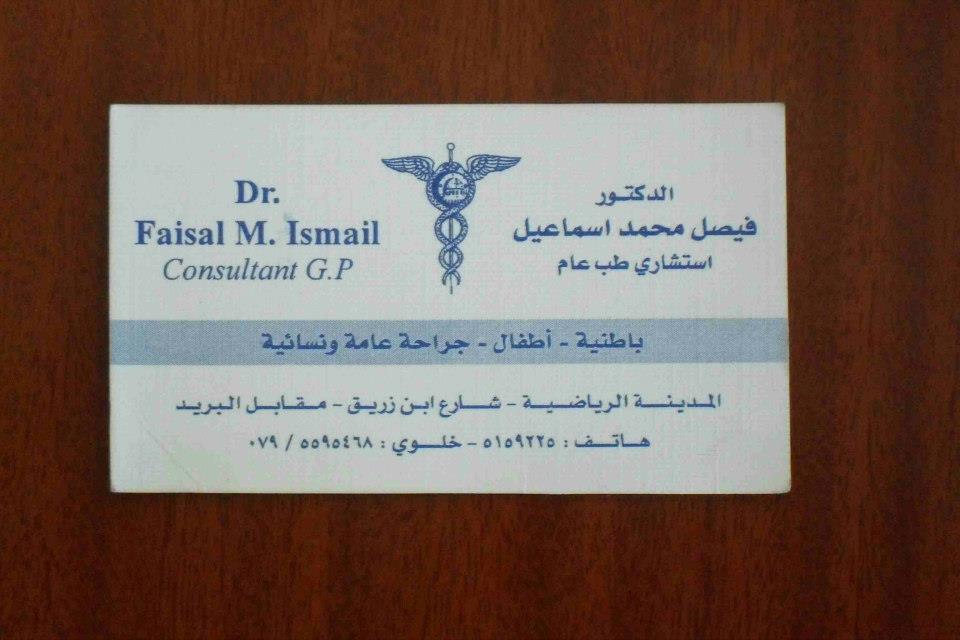
This is about the fraudulent medical practice of Faisal M. Ismail (فيصل م. اسماعيل).

After unsuccessfully obtaining a cure in Alexandria for my deteriorating skin condition.  I decided that I needed to get home as soon as possible.  However, the pain was too much and I could not think of anything else.  I was suppose to fly after a week, but I started to think that I’d not survive another day.

By this time, I had already met my Jordanian friend, but he had been slow to do anything, (which I should have taken as a bad omen).

So I contacted a Saudi friend, whom I previously met at the Talal Abu Ghazaleh Knowledge Centre (مركز طلال أبوغزاله للمعرفة), to ask where I could get a second opinion.  It turned out that my friend was still in Jordan, but in another town (I’d been wrongly informed by an idiot that she had left the country) and she recommended a private doctor, Dr Faisal Ismail, near Sport city.

I asked about the hospital down the road, but she said that they were crooks.  In fact, she had already spoken to the Faisal Ismail and advised me to call immediately.  So I did…

Faisal Ismail told me to come down that very night and when I arrived he asked me to take my shoes off, which I happily did except that by doing so was also very painful.  In person he was a lot more friendlier than on the phone.  He sounded like a man of experience and he talked about a great many things (medical and non-medical); I also learned that he was married with at least one son.

When he returned to the operating room, upon seeing my condition, he immediately gasped and said ‘Have you been bitten by insects!?!’

Soon later he had done his work and the pain was finally gone.  The areas were bandaged and he applied various inoculations.  Then he scolded me…

..”This is what happens when you choose a cheap country in order to save money”.  I was a little confused with that statement.  I had chosen Egypt for the quality of teaching and not the price.

Of-course I was grateful (and possibly too much) for fixing me up.  The price he asked for sounded great too.

Unfortunately, he spoiled his good work by continuing to speak ill of Egypt.   He claimed that, due to the food being unsafe in Egypt, he always gave vaccination to his patients.  I had visited Jordan before and knew that the food in the restaurants was also of low quality (actually a lot worse).   He also claimed that the hotels were unhygienic and that he had once refused to travel to Egypt to treat somebody even when the hotel was paid for.  On one hand, since he was a medical professional, thought I should listen to him.  On the other hand, I just wanted him to shut-up.  However, what was to follow was even worse.

After my first follow-up examination, he told me my recovery was good, but that I needed several more check-ups, which meant I would not be able to fly home as originally scheduled.

One year later, I could not help wonder whether the check-ups were just a way to increase his income.  He often talked about charity (as well the subject of marriage) and now I know how he funded that.

My Saudi friend mentioned how the doctor did not charge so much (and for her female friends).  However, when I added up all the costs, I did not see much of a discount.

I really started to suspect something when a nurse, who was my language partner from the Ali Baba library, believed I did not need so many check-ups.

Worse than that, crossing paths with him also affected my long term plans.  I delayed flying home and he advised me not to return to Egypt.

Doctor knows best I suppose.

SOAS Language Centre

When I first discovered the SOAS Language Centre, I used to get lost around Russell Square…

Back in the days, I tried learning Urdu and Arabic at the Language Centre. I did not want to waste any time and thought university to be best environment.

However, this language centre had nothing to do with the degree programmes at the School of Oriental and African Studies. Rather, this was part-time study in the evenings, taught by non-faculty staff.

For Urdu, I never really progressed with the grammar, perhaps because I started in too high a level. However, they were the ones who chose the level for me.

As for Arabic, initially it seemed rather fun and engaging, but I was eventually put off. My first teacher (native speaker from Egypt doing a PHD) would somewhat teach us colloquial even though it was a Modern Standard Arabic (MSA) course.

My final teacher (a Palestinian from Syria studying a masters) was not much better, she often criticised MSA constructs because nobody uses them in speech.

It was like they needed to be often reminded that we (the students) had paid to be taught MSA.

One thousand pounds later, most of us felt that we had not learned anything useful. Frustrated, I somewhat turned my back on learning foreign languages.

Perhaps I should have taken this as a bad omen for studying in the Middle East.

British and French mandatory policies in Iraq and Syria between the two World Wars

Here I compare and contrast Iraq with Syria (specifically what later became the country Syria as opposed to Greater Syria, which might include Lebanon), focusing on political and economic sovereignty. After the First World War, the League of Nations entrusted the Iraqi mandate to the British Empire and the Syrian mandate to the French Empire. Initially, both Iraq and Syria came under direct rule from Britain and France respectively, but later experienced limited self-rule and eventually gained independence. However, as will be shown, the timetable and method used by these ‘former’ colonial Powers differed greatly.

Iraq was constructed from the three Ottoman provinces: Basra, Baghdad and Mosul. By the end of the First World War, Britain more or less occupied all three territories and for economic and security reasons decided to consolidate them. From ‘1921 Britain adopted a policy of devolving responsibilities to an ‘Iraqi’ government.’ This government was headed by a monarch and for that the British chose Faisal Husain (of the Hashemite dynasty, which had led the Arab revolt in Arabia during the First World War), who was forced to leave Syria (see below). Consequently, the new political and military elite of Iraq were made up of Amir Faisal and his Sharifian entourage – most of whom were Sunni Arabs. However, over half the Arab population were Shi’a, who did not trust British ambitions and were not keen with the idea of the new state if it did not fairly represent the Shi’a majority. In other words, a Shi’a nation ruled by a Sunni ex-Ottoman elite. This was complicated further by the Mosul province that included part of the ‘homeland’ of the Kurdish people (most of whom were Sunni). Including all three provinces in the new Iraq made the Shi’a the minority. However, Kurdish tribal leaders sought more autonomy and had significant support amongst their people. In addition to force and limited Iraqi self-rule, Britain used patronage to pacify the Iraqi leaders. Eventually, this worked with some of the Shi’a leaders in the South (especially after the main mujtahids had left for Iran).

Syria was also constructed from smaller Ottoman entities. The mandate (approved in 1922) ‘defined the objective of French rule as “to facilitate the progressive development of Syria and Lebanon as independent states”.’ However, France initially implemented policies similar to those used in its existing colonies elsewhere. Instead of using Amir Faisal to work towards an independent state, they ejected the ‘Arab nationalist Hashemite-led administration’ (that had arrived in Syria’s capitol of Damascus before the French) and replaced it and the previous Ottoman institutions. Syria’s Muslim population was eight-five percent, but unlike Iraq, the majority of Syria’s population was Sunni Muslim. They also made-up most of the traditional ex-Ottoman elite, but France had demoted their status by giving preference to minority groups (some of whom had been neglected by the Ottomans) . Many of the officials of the new administration were Frenchman and also lacked the necessary language skills (although this changed later). Most of the natives they employed were usually Christian and rarely Sunni Muslim. The ‘French staff officers generally held a low opinion of Arab Muslims, Kurds, and Druzes’ and even had a low opinion of the Syrian Officials they did employ. Even though in the long term, a large number of Frenchman were stationed in Syria there was little attempt to assimilate with the native people.

British policy towards Iraqi rule had initially been represented ‘by those who came to be known as the ‘imperial school’.’ For this reason direct rule had been attempted initially, but due to widespread dissatisfaction and unrest (which was seen as a result of direct rule and was very costly to suppress), it was decided that a more indirect form of rule should be pursued. This long term policy of indirect rule was illustrated in November 1920 when an ‘Iraqi’ government was formed, headed by the naqib al-ashraf of Bagdad, Sayyid ‘Abd al-Rahman al-Kailani, and with twenty-one Iraqi ministers. It was Sunni dominated but the ministers were from all three provinces and included a few Shi’a and Christians and one Jew. Here at least the British were taking note of Iraq’s demographics. The former Ottoman administrative units and municipal councils were also restored, ‘and Iraqi officials began to replace British political officers in the provinces (except in the Kurdish district of Sulaimaniyyah).’ However, British advisors assisted the Iraqi officials in the provinces and were attached to the new ministries. In June 1921 a ‘bogus referendum was held in which it was claimed that 96 per cent of the population of Iraq accepted the new king’ Faisal Husain ‘and on 23 August 1921 Faisal was ceremoniously enthroned.’ Britain control of Iraq was via treaties and in 1922 an Anglo-Iraqi treaty recognised the devolving of power to the Iraqi government. However, control was retained by Britain of financial, international, security and certain judicial affairs . This treaty was opposed by a great number of the masses as well as the elites. It is argued that Iraq had no choice but to accept the 1922 treaty, and that Britain gave the Constituent Assembly an ultimatum to ratify it. The meaning of this is that Iraq had not achieved full political sovereignty, nor did it have zero control over its affairs, but that Britain indirectly controlled Iraq. This in essence was the mandatory policy of Britain between the wars.

While Britain tried to unite the three provinces of Iraq, the French decided to divide Syria into three autonomous regions ‘with separate areas for the Alawis on the coast and the Druze in the south.’ Also, politically the French did not give any representation to the majority Sunni population whereas in Iraq representation was given to the Shi’a – albeit not accurately reflecting their percentage of the population. The ‘French administration was an oversized and expensive bureaucratic ship’ and eventually much of the financial burden of defence and public security was shifted onto the Syrian people. In Iraq the British were somewhat concerned with cost-effectiveness and therefore decided on indirect control. In other words, the British were prepared to use any means to gain from the Iraqi mandate (even as late as 1930 a treaty was signed – see below). Whereas the French were determined to keep direct control over the population, which in practice meant denying opportunities to the majority. In Iraq, an Arab nationalist (Amir Faisal) had become king, but in Syria the nationalists were denied the top jobs. Both Britain and France used and would continue to use force in their mandates. However, France’s method of relying on minorities and a large foreign administration (and army) was both costly and unstable. This also denied political experience to the Syrians when the state finally became independent.

Economic policy in Iraq could be dictated by patronage, which might include tax exemptions. Land-reform was sometimes used in order to maintain the power of the pro-Hashemite ruling elite or pacify potential enemies of the state. Several development projects had been planned and even implemented during the 1920s, however, most of the King’s energies and resources were devoted to ensuring his political survival. In the 1930s, the King had encouraged agricultural development, but lack of interest from affluent Iraqis and the British to invest meant that production from this sector was not increased. Britain’s significant economic policy towards Iraq concerned oil and via the Turkish Petroleum Company (TPC) Britain acquired favourable concessions. Therefore, apart from oil, Britain did not really develop Iraq’s economy and in the 1930s Iraq faced economic difficulties. However, this is in part due to the world-wide economic recession – starting in 1929. Moreover, Britain’s economic policies were not directly harmful to the local economy.

On the other hand, French economic policy included controlling Syria’s monetary system. This fixed a new Syrian currency to the Franc, which later caused problems when the French currency lost it value to the US dollar. France also sold public utilities to French businesses and the transfer of the Muslim-owned Hejaz Railway to a French railroad company in 1924 caused a big outcry and protest in Syria. According to P. S. Khoury, the French violated the Mandate charter by favouring French business to the extent that it did not allow equality of opportunity to all members of the League of Nations. Also, the French High Commission unfairly served the interest of French businesses by manipulating markets, which caused harm to Syrian businesses. For example, false rumours of a bad harvest were spread and then grain exports were banned. French agents were then able to buy grain cheaply and sell at a higher prices when the borders were re-opened for export. There was generally a lack of encouragement or will (on the part of the French) to develop the Syrian economy, but only to further French commercial interests.

Britain’s significant policy in Iraq was intended to safeguard her trading interests in the Basra province and elsewhere and to guarantee access to oil in the region. This meant pursuing a very difficult policy of nation-building a state made up of the three most ethnically and religiously diverse Arab-majority regions of the former Ottoman Empire. The Ottoman Empire had hitherto administrated these lands as separate decentralised provinces. But Britain wanted a buffer (Baghdad) for the southern Basra province and a buffer (Mosul) for Baghdad and its policies were indifferent to the local situation. Oil made a unified Iraq even more important and it was vital to maintain the power of the Hashemite King (who was Arab, had religious significance and a British ally). As long as Britain’s commercial and security objectives were met her policy was quite relaxed in other areas. Existing elites were encouraged to work with the largely new Sharifian elites. Also, there was not much intrusion in religion, for example, the Organic law of 1925 made Islam the state religion. The main issue of the Shi’a was political power – they were under-represented. In Syria, however, the French decided and maintained a large presence and left the country only as late as 1946. Their policy was direct rule and economic control. Britain’s and France’s policies were similar in that neither country wanted true sovereignty for their mandates. The British would only support it as long as their interests were satisfied so their intentions were similar to the French. The difference is whereas Britain’s policies can clearly be seen as paving the way for Iraqi native rule, France’s policy is seen by P. S. Khoury and W. L. Cleveland as though Syria was a mandate only by name, and in practice a newly acquired colony to exploit and deny sovereignty to.

Bibliography

Cleveland, W. L, A History of the Modern Middle East, 1994, Boulder.

Eppel M, Iraq from Monarchy to Tyranny: From the Hashemites to the Rise of Saddam, Florida: 2004, University of Florida.

Khoury, P. S, Syria and the French Mandate: The Politics of Arab Nationalism 1920-1945, London: 1987, I. B. Tauris & Co. Ltd.

Tripp, C, A History of Iraq, Cambridge: 2000, CUP.

Yapp, M.E. The Making of the Modern Near East 1792-1923, London: 1987, Pearson Education.