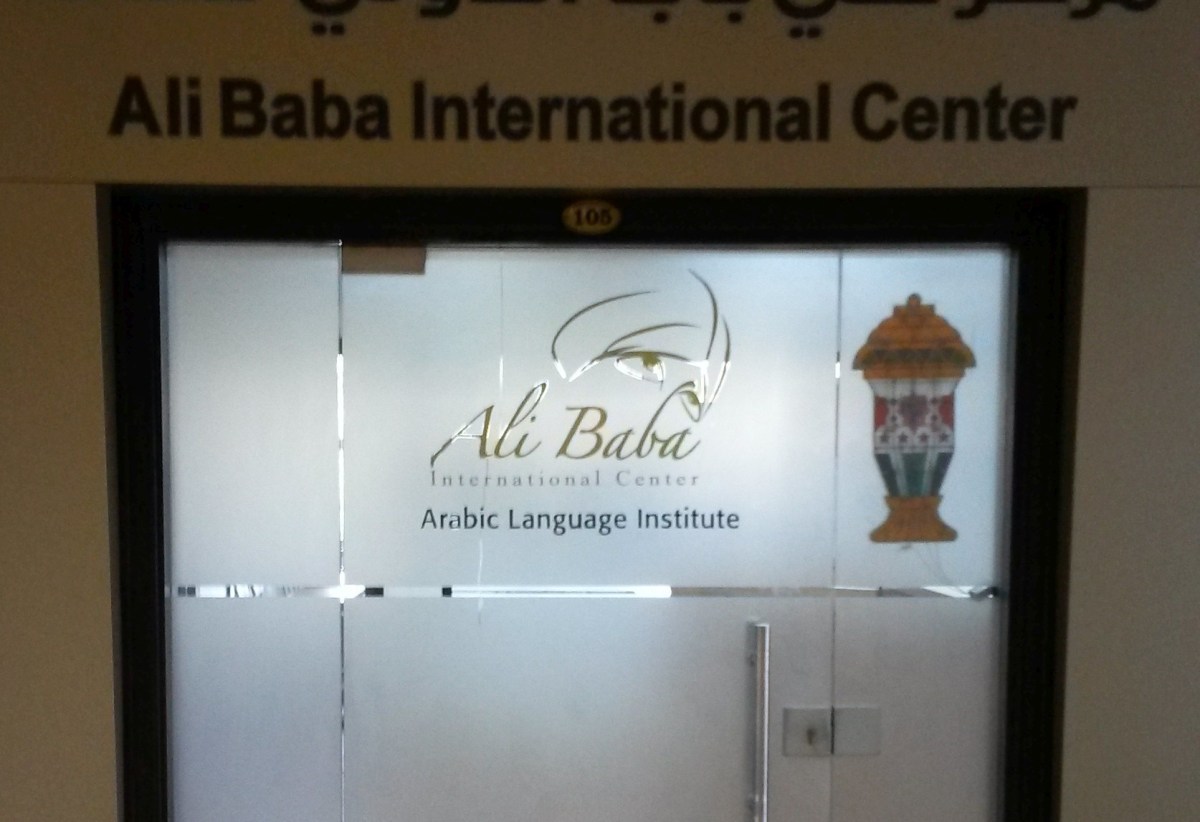
Ali Baba

The Ali Baba International Center focuses on learning both German and standard Arabic.

Ali Baabaa is not very well known, which is probably why I was only able to study here for one month.  After that there were no more students of intermediate level.  Their busy period might of been  during the summer and the month of January.

For a private institute, I was quite impressed.  There was no bored director greedy for US dollars or playing games with the student’s level.

Perhaps more importantly, the teachers were very polite and clearly skilled professionals (or at least trying to appear as such).  In fact, the teaching style was similar to that of the TAFL Center in Alexandria, but without the abuse and discrimination.

Yes, initially, the name made me laugh too, but in the end the joke was on me. This really is a genuine place for the serious student of Arabic.

Although I only studied here for four weeks, I gained a lot more than I expected, much more than from the so-called university opposite.

Qasid

I use to doubt an institute that grew out of a sufi order could teach me Arabic.  I was probably wrong!

In fact, it is suppose to be the best centre in Jordan for studying Arabic.  However, the way it was described to me by the director it sounded a little too intense.  More than any US university and probably more than SOAS, he also claimed.  It’s possible that he was not in a position to really know.

I use to fear that enrolling here might include being harassed to participate in extra-curricular activities.  In fact, back at the TAFL center in Alexandria, I was pressured by the director to attend a sufi dance event (I think for cultural and entertainment reasons and not religious) yet it was being held on the same day as one of the centre’s weekly trips (how would I find time for all of this and still learn Arabic, especially with my troubles in the apartment full of cat fleas).  On another occasion, I felt obliged to attend (by myself) a lecture in Egyptian Colloquial Arabic being held at the French institute.  When it came to ECA I was weakest in my class, yet somehow I was the most suitable to attend.

However, having met the director of Qasid I feel it would have been a different story here.  He seemed too humble, friendly and content to play that kind of game.  So I reckon (and from what I have heard) the only harassment a student would face here is the teachers making him or her do the homework.  And that’s almost always a good thing.

From the reception (where I ended up sitting for a long time so went looking for somebody helpful) when I first entered (perhaps it was just a caretaker/janitor) I did not feel very welcomed (as in, we have enough students and we do not care if you join or not).  Perhaps that could be a good thing.  I was tired of directors desperate after my money and totally uninterested in education.

With hindsight, this is probably all I needed to complete my Modern Standard Arabic studies.  Too bad I never enrolled here.

An-Najah National University

Is situated in Nablus, in the West Bank (Palestine).  Apparently, it is an excellent centre to study Arabic, but being surrounded by Israel, thought it might feel like a prison.

With hindsight, I think it would have been worth it.  The feedback from students, enrolled at the School of Oriental & African Studies, was positive.

Besides, there are way more riskier places one could be, including Gaza and the TAFL center in Alexandria university.

Damascus

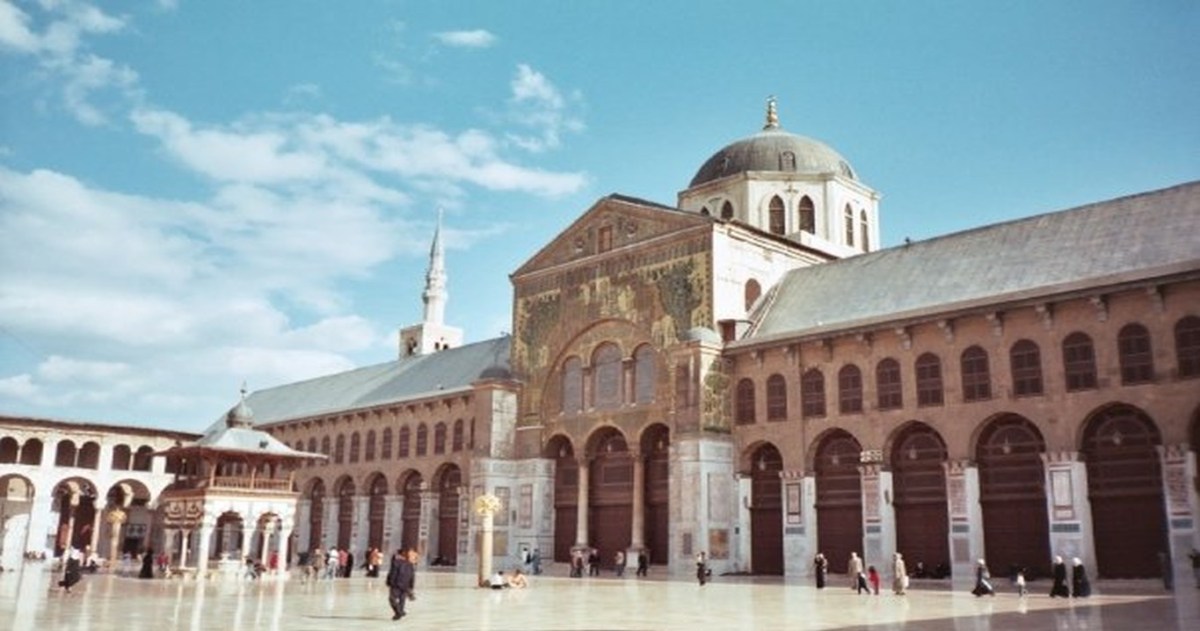
Damascus is the capital of modern day Syria and in a historical context is seen as the centre of “Sha’am”.  Here, you could still feel the old world.  Local tradition and culture is still alive here even with the abundance of satellite TV and Internet cafes.

Damascus is said to be the world’s longest continually inhabited city (I think there are even biblical references). At one time it was the capital of the Umayyad/Arabian republic.

More importantly, I use to regret not having studied in Damascus (before the problems).  I had been put off by the racism in immigration against the Asian diaspora in Europe and America, and the lack of improvement for the most impoverished in Syria.  Having said that, more recently the ‘animals’ stationed at the borders had been replaced with more cultured men, who warmly welcomed foreigners learning Arabic and would speak to them in standard Arabic.

Surprisingly, by returning to Jordan, I perhaps still attained some of what I originally wanted.  Interestingly, one of my teachers in Jordan was a Syrian, who had been teaching Arabic to foreigners at the Damascus university before the civil war started in his country.

He did not like the Jordan university centre’s style of teaching and apparent lack of grammar in the textbook. He loved grammar and although we found it difficult at first, he eventually drilled it into us.  It use to be that the only real benefit from Jordan was the vocabulary, but this Syrian teacher gave us that and much more.  It’s even possible that he taught more than what the students in the level above us were learning.  He had a unique and effective way of teaching.

A few of the students wanted less grammar in class and complained about him to the director.  The teacher felt that we were weak in some of the basics and so he spent some of the first few weeks blitzing through what he thought we should already know.  Most of us were content with that, but some were clearly not.  I did not mind, since I believed he was really trying to help us, and it worked.  The real issue for me was that he gave me that look of ‘why did you not complain to me first’ when actually it was not me who complained to anybody.

He would also go irate when I went in late for class or when I did not do all my homework (even when I was sick).  I sometimes felt sorry for him because he was getting paranoid, he believed that there was some conspiracy against Syria.  He use to share some of the horror stories regarding the conflict in his country.

I did not always understand his religious and political opinions, but after the lazy summer, this was just what I needed and I felt he gave a very good introduction to Arab culture.

After he left for Turkey, we really missed him.  Those of us who remained in Jordan were left to face the UJLC bullshit and we quickly realised that we had not valued our Syrian teacher enough.
SOAS Language Centre

When I first discovered the SOAS Language Centre, I used to get lost around Russell Square…

Back in the days, I tried learning Urdu and Arabic at the Language Centre. I did not want to waste any time and thought university to be best environment.

However, this language centre had nothing to do with the degree programmes at the School of Oriental and African Studies. Rather, this was part-time study in the evenings, taught by non-faculty staff.

For Urdu, I never really progressed with the grammar, perhaps because I started in too high a level. However, they were the ones who chose the level for me.

As for Arabic, initially it seemed rather fun and engaging, but I was eventually put off. My first teacher (native speaker from Egypt doing a PHD) would somewhat teach us colloquial even though it was a Modern Standard Arabic (MSA) course.

My final teacher (a Palestinian from Syria studying a masters) was not much better, she often criticised MSA constructs because nobody uses them in speech.

It was like they needed to be often reminded that we (the students) had paid to be taught MSA.

One thousand pounds later, most of us felt that we had not learned anything useful. Frustrated, I somewhat turned my back on learning foreign languages.

Perhaps I should have taken this as a bad omen for studying in the Middle East.

Ibn Abd al-Wahhab

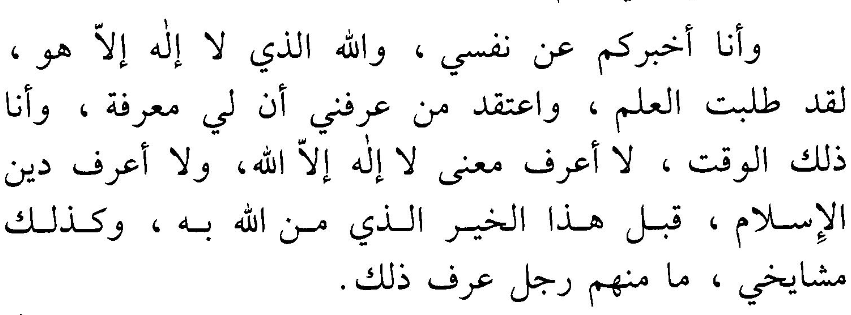
Recently, Yasir Qadhi described ibn Wahhab as an extremist and mentions that he saw himself as enlightened and the rest of the world in darkness. He cites a passage from the the following book: ad-Durar as-Saniyyah fi al-Ajwibah an-Najdiyyah.

However, others say his translation is inaccurate. Has Yasir Qadhi forgotten the Arabic language?

Here is my translation:
Let me inform you about myself: (I swear) by God, of whom there is no other.
Certainly, I sought knowledge and I think (he) who knows me (knows) I have a (deep) knowledge.
(Actually, at) that time I (did) not know the (true) meaning of no deity except God, and I (did) not know the (true) meaning of the religion of Islam; before (the coming of) this good fortune, which is from (the grace of) God.
And likewise my teachers, not one of them knew (the meaning of the above).

Sources:
https://archive.org/details/WAQ41814/10_41823/page/n49/mode/2up?view=theater
https://www.youtube.com/watch?v=-pkk0LPDUoA (What Yasir Qadhi says about Ibn Abdul-Wahab)
https://www.youtube.com/watch?v=LApxhOAejn4 (Did Muhammad bin Abdul Wahhab Rebel Against The Ottoman Empire)
http://download.salafimanhaj.com/pdf/SalafiManhaj_Ottomans.pdf